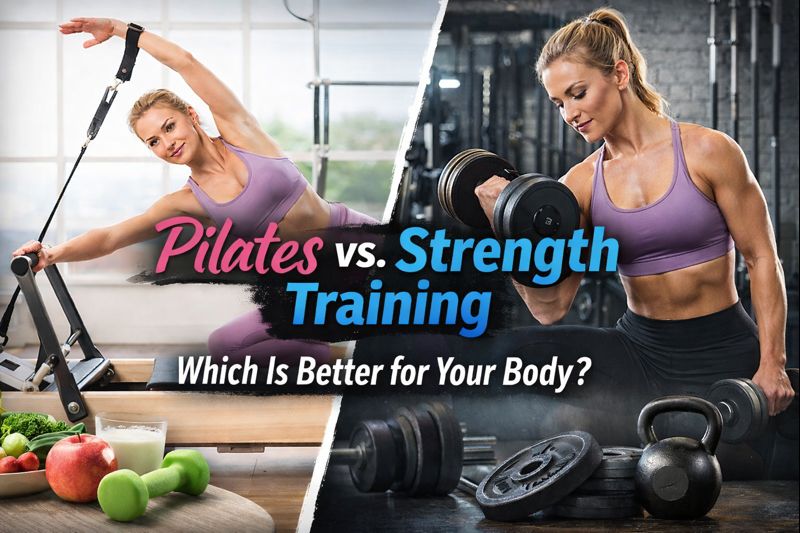
Is Pilates Replacing Strength Training in 2026?
Is Pilates Replacing Strength Training in 2026?
Lately, everywhere you scroll on social media someone’s claiming that Pilates is the workout that transformed their body. Influencers will tell you their “dream body” came from Pilates, and next thing you know… you’re signing up for a class. Maybe you even love it — and that’s awesome — but is it superior to strength training for changing your body?
Let’s break it down — realistically, scientifically, and without the trend-chasing hype.
The Reality: What Actually Changes Your Body
Before we compare Pilates and strength training, we have to be clear on how body changes happen:
1. Weight Loss = Calories In vs. Calories Out
You can’t lose weight without being in a calorie deficit. This is foundational and totally independent of your workout style.
2. Body Composition = Diet + Training + Macros
Changing how your body looks — less fat, more definition — comes from your nutrition and hitting the right macronutrient targets, especially protein.
3. Muscle Definition = Muscle Protein Synthesis (MPS) > Breakdown
Muscle growth (hypertrophy) only happens when your resistance training stimulates muscle breakdown and repair, and you supply adequate protein so MPS outweighs Muscle Protein Breakdown (MPB). That’s science, not social media.
What the Research Says About Pilates
Here’s a key quote from a scientific study that helps clear up the rumors around Pilates:
“Regular participation in exercise programs can promote positive changes in body composition. The magnitude of these changes is mediated by the total volume of exercise (i.e., frequency, intensity, duration) and other factors, such as age, gender, and diet… Furthermore, Alandro-Gonzalvo et al. (2012) underlined that there is poor empirical evidence indicating a conclusive effect of Pilates exercises on body composition. Future investigation needs to determine if a tailored Pilates exercise alone or combined with other activities can positively affect body composition.”
In this study, mat Pilates did improve strength in certain functional tests, but it did not meaningfully change body composition on its own after 12 weeks — likely due to low total exercise volume and no diet changes.
Another systematic review found limited quality research and concluded there’s poor empirical evidence that Pilates alone changes body composition overall.
Strength Training vs. Pilates
Here’s what exercise science generally supports:
✔ Strength Training (Weights, Barbells, Dumbbells, Kettlebells)
Built for progressive overload — you can continuously increase resistance as you get stronger.
More effective at stimulating muscle hypertrophy and increasing muscle mass.
Better for bone density, metabolic health, and long-term functional strength.
✔ Pilates (Mat or Reformer)
Great for core strength, stability, posture, mobility, flexibility, and neuromuscular control.
Can improve muscle endurance and certain strength markers.
But as resistance alone, it tops out — once you adapt, there’s less capacity to keep progressing muscle growth compared with traditional strength training.
In other words: Pilates complements strength training well, but it doesn’t replace it when your goal is muscle growth and definition.
So Why Do Influencers Look Good Doing Pilates?
There are a few reasons people often confuse correlation with causation:
If someone was already eating well and training consistently, their body changed because of those habits — not simply because of Pilates.
Pilates helps posture, core control, and movement quality — so people may appear more toned even without significant muscle mass increases.
People who enjoy Pilates tend to stick with it, which improves consistency — and consistency is a huge part of long-term results.
A recent expert summary also points out that many marketing claims around Pilates promising dramatic body composition changes are misleading and usually require calorie deficit and resistance training to be true.
What Really Matters
Here’s the honest bottom line:
Do what you enjoy — that’s what you’ll stick to.
If you genuinely love Pilates, great. It’s fun, low-impact, builds core strength, and may boost overall well-being. But if your goal is muscle growth, definition, strength, and long-term metabolic gains, you’re going to get far better results from structured strength training with progressive overload plus solid nutrition.
The best approach? A mix of both if you enjoy it:
Strength train 3–4x/week for muscle growth and metabolic health
Add Pilates as a way to improve flexibility, mobility, and recovery
Eat enough protein and stay in the right macro balance for your goals
Personal Note
I strength train 4x a week, do yoga once, and if I have time I’ll do Pilates once because it’s fun and challenging in a different way — but it’s not my primary tool for muscle building. Strength training still drives the changes I care about most.

